GST vs Income Tax Difference – Business Owners ke liye Simple Guide
Ek real-life kahani se shuruaat
Sandeep Gupta, Indore me ek small wholesale stationery business chalata hai. 5–6 regular retailers usse maal lete hain, aur mahine ka turnover theek-thaak ho jata hai. Business chal raha tha, lekin ek cheez usko hamesha confuse karti thi.
Har mahine accountant bolta tha, “GST return file karni hai.”
Financial year ke end me wahi accountant bolta, “Ab Income Tax ki planning karni hai.”
Sandeep ka simple sawaal tha:
“Tax to ek hi hota hai, phir GST aur Income Tax alag-alag kyun?”
Agar aap bhi business chalate hain aur ye confusion kabhi hua hai, to ye guide aapke liye hai.
Ground reality: Business owners ki real confusion
Small aur medium business owners ke liye tax ka biggest challenge calculation nahi, samajh hota hai.
GST alag, TDS alag, Income Tax alag.
Returns ki alag dates, portals alag, rules alag.
Kabhi notice ka fear, kabhi penalty ka confusion.
Bahut log GST ka paisa apna samajh kar kharch kar dete hain, aur baad me payment time par problem ho jati hai.
Bahut log Income Tax ke liye proper expense record nahi rakhte, aur unnecessary tax bhar dete hain.
Yeh confusion normal hai, aur isi wajah se GST aur Income Tax ka difference samajhna zaroori hai.
GST aur Income Tax kya hote hain – simple shabdon me
Simple shabdon me bole to:
GST ek indirect tax hai.
Income Tax ek direct tax hai.
Indirect tax ka matlab:
Customer tax deta hai, business collect karke government ko deta hai.
Direct tax ka matlab:
Jo income aap kamate ho, us par aap khud tax dete ho.
Yahi basic difference hai.
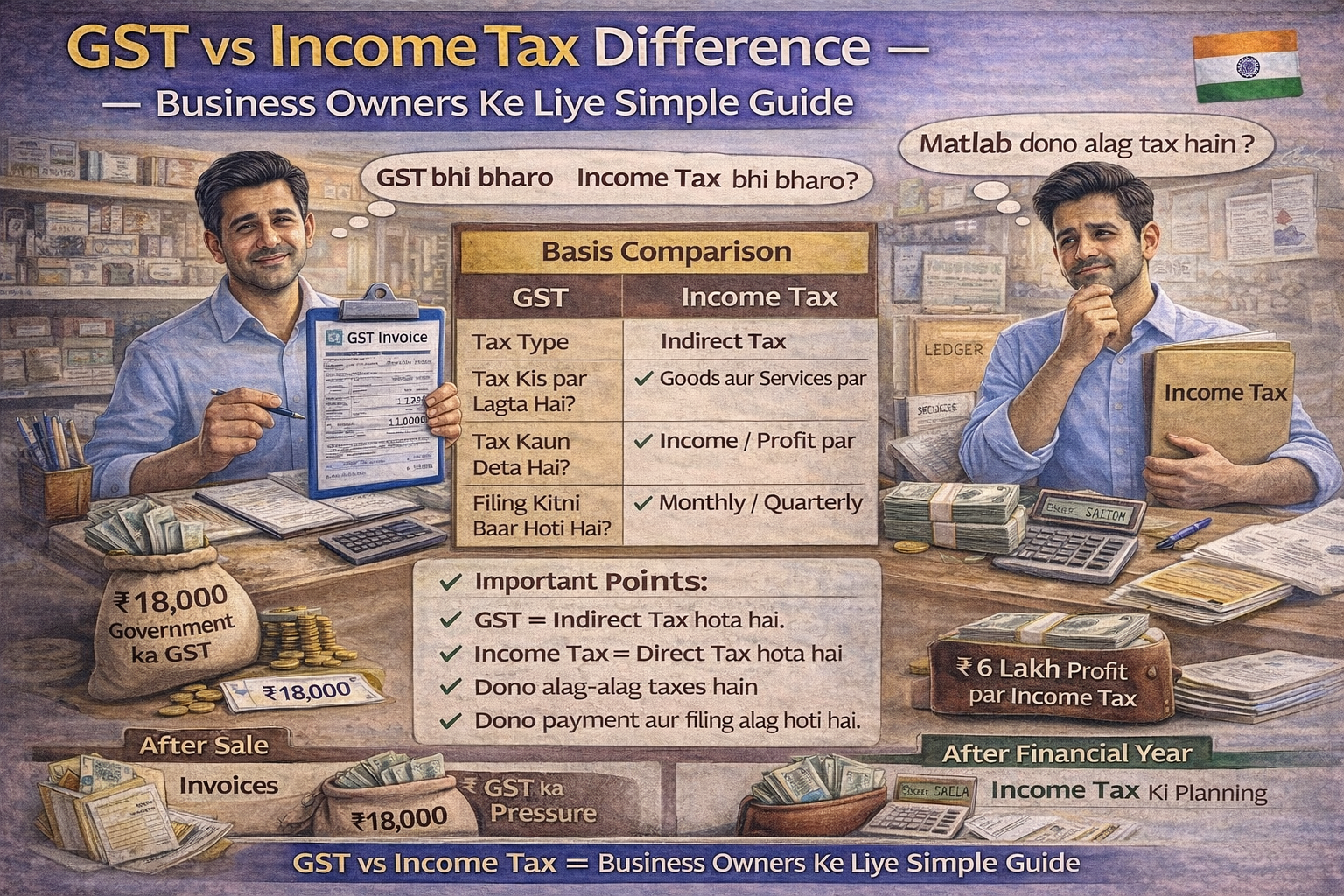
GST vs Income Tax – basic difference table
| Basis | GST | Income Tax |
|---|---|---|
| Tax type | Indirect tax | Direct tax |
| Kis par lagta hai | Goods aur services ki sale par | Profit ya income par |
| Kaun pay karta hai | Customer (business collect karta hai) | Individual ya business |
| Filing frequency | Monthly / Quarterly | Yearly |
| Department | GST Department | Income Tax Department |
Yeh table basic difference samjhata hai, lekin practical difference aur bhi important hai.
Law kya kehta hai aur practical reality kya hoti hai
Law ke hisaab se GST sirf ek pass-through tax hai.
Matlab business sirf collector hai, payer nahi.
Practical reality me kya hota hai:
Bahut se businesses GST ka paisa working capital me use kar lete hain. Jab return file karne ka time aata hai, tab fund arrange karna mushkil ho jata hai.
Income Tax me law kehta hai ki profit par tax lagega.
Practical reality me profit ka calculation hi galat ho jata hai kyunki expenses properly record nahi hote.
Isliye difference sirf definition ka nahi, mindset ka bhi hai.
GST ka practical example
Maan lo Sandeep ne goods beche:
Sale value: 1,00,000
GST: 18,000
Customer ne total diya: 1,18,000
Yahan 18,000 Sandeep ka income nahi hai.
Woh government ka tax hai jo usne temporarily hold kiya hai.
Income Tax ka practical example
Same Sandeep ka yearly calculation:
Total sales: 40 lakh
Total expenses: 34 lakh
Profit: 6 lakh
Ab jo tax lagega, woh 6 lakh par lagega.
Yeh Sandeep ka actual tax hai.
Compliance pressure ka real difference
GST me pressure frequency ka hota hai.
Monthly returns, reconciliation, ITC matching.
Income Tax me pressure accuracy ka hota hai.
Profit calculation, deductions, audit.
Isliye dono ka stress alag type ka hota hai.
GST aur Income Tax filing ka process – kaise hota hai
GST filing process generally:
Step 1: Sales aur purchase data prepare hota hai
Step 2: GSTR-1 aur GSTR-3B file hoti hai
Step 3: Tax payment hota hai
Step 4: Reconciliation hoti hai
Ye process online GST portal par hota hai.
Income Tax filing process:
Step 1: Books finalize hote hain
Step 2: Profit and loss statement ready hota hai
Step 3: Deductions calculate hoti hain
Step 4: ITR file hota hai
Ye process Income Tax portal par hota hai.
GST aur Income Tax ke pros aur cons – practical view
GST ka advantage ye hai ki tax burden ultimately customer par hota hai.
Lekin compliance frequent hoti hai aur mistakes jaldi pakdi jaati hain.
Income Tax ka advantage ye hai ki saal me ek baar filing hoti hai.
Lekin agar records clear nahi hain, to tax zyada lag sakta hai.
Isliye GST discipline demand karta hai, aur Income Tax planning demand karta hai.
Kab GST zyada impact karta hai aur kab Income Tax
Agar aap trading ya manufacturing me ho, GST ka impact daily business par zyada hota hai.
Agar aap service professional ho, Income Tax planning ka impact zyada hota hai.
Yeh business type par depend karta hai.
Kuch common sawal jo log poochte hain
Log aksar poochte hain ki kya GST bharne ke baad Income Tax nahi bharna padta.
Sach ye hai ki dono alag taxes hain, aur dono applicable ho sakte hain.
Kuch log poochte hain ki kya GST ka paisa profit me count hota hai.
Nahi, GST income nahi hota, sirf liability hoti hai.
Ek aur common doubt hota hai ki kya small business ko Income Tax nahi dena padta.
Agar profit hai aur limit cross hoti hai, to dena padta hai.
Kab dikkat shuru hoti hai
Problems tab aati hain jab:
GST aur Income Tax ka record mix ho jata hai
Personal aur business account mix ho jata hai
Invoices proper maintain nahi hote
Yeh choti galtiyan future me notices ka reason ban jaati hain.
Conclusion
Sandeep ko jab yeh samajh aaya ki GST uska tax nahi, balki responsibility hai, aur Income Tax uska actual tax hai, tab uski clarity aa gayi.
Usne ek simple rule follow karna shuru kiya:
GST ka paisa alag rakho, profit ka record clean rakho.
Tax system complicated lag sakta hai, lekin basic concepts clear ho jaayein to aadhi tension khatam ho jaati hai.
GST aur Income Tax dono zaroori hain, lekin dono ka role alag hai. Jo business owner yeh difference samajh leta hai, uske liye compliance manageable ho jaata hai.

Vivek Bhargava is a business and legal content researcher who writes simplified guides on Indian startup laws, taxation, and compliance requirements. His goal is to help entrepreneurs understand complex legal topics in a clear and practical way.
The information published on this website is based on official government notifications and publicly available legal resources.
Disclaimer: The content provided here is for informational purposes only and does not constitute legal advice. Readers are advised to consult a qualified professional for specific legal matters.