
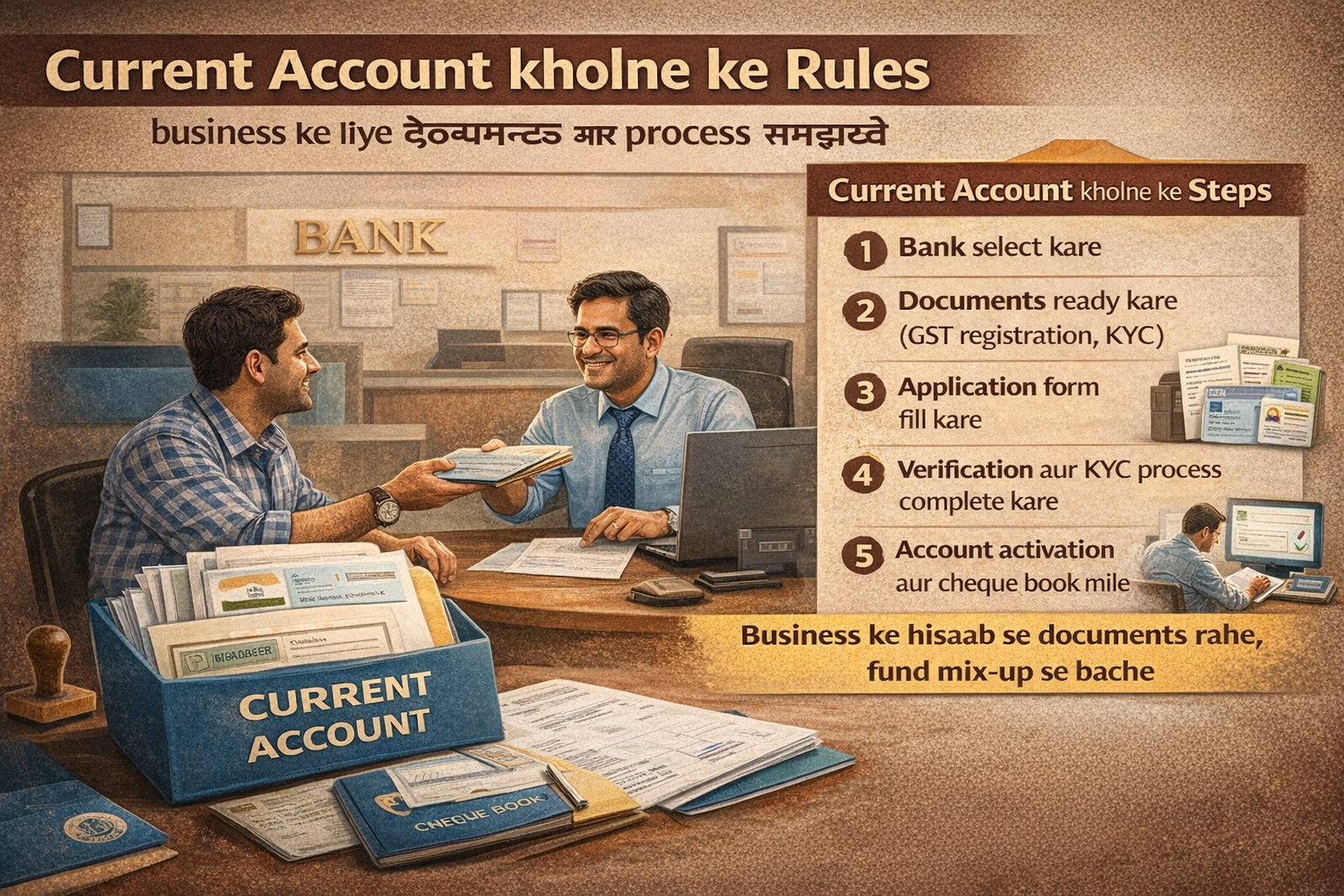
Current Account Kholne ke Rules – Small Business ke liye Practical Guide
Ek real situation jo roz dekhne ko milti hai
Sandeep Indore me ek small hardware supply ka business start kar raha tha. Pehle wo personal savings account se hi payments le raha tha. UPI aur bank transfer bhi wahi par aa rahe the.
Ek din bank se call aaya aur unhone bola ki business transactions zyada ho rahe hain, aapko current account open karna padega.
Sandeep confuse ho gaya. Usko laga current account sirf badi companies ke liye hota hai. Accountant ne bola zaroori hai, bank ne bola rules hain, par clearly kisi ne samjhaya nahi ki current account hota kya hai aur kab zaroori hota hai.
Ye situation bahut common hai.
Small business owners ko current account ko lekar confusion kyun hoti hai
Ground reality me business start karte waqt log focus karte hain:
Sales kaise badhe
Supplier kaise mile
Payments kaise aaye
Banking compliance par initial stage me zyada dhyan nahi diya jata.
Phir problems start hoti hain:
Bank transactions par queries aane lagti hain
KYC update ke calls aate hain
Account freeze ka fear hota hai
GST aur bank statements mismatch hone lagte hain
Aur tab samajh aata hai ki current account ek formality nahi, necessity hai.
Simple shabdon me samjhe: Current Account kya hota hai
Simple shabdon me bole to current account business transactions ke liye banaya gaya bank account hota hai.
Isme:
Unlimited transactions possible hote hain
Frequent deposits aur withdrawals allowed hote hain
Business name me account operate hota hai
Savings account personal use ke liye design hota hai, jabki current account business activity ke liye.
Current Account kholne ke basic rules kya hain
India me banks ke general rules similar hote hain, chahe PSU bank ho ya private bank.
Business proof hona zaroori hota hai
Bank ko ye proof chahiye hota hai ki aap genuine business activity kar rahe hain.
Examples:
GST registration
Shop and Establishment certificate
MSME registration
Trade license
Agar proprietorship hai to owner ke naam par business proof lagta hai.
KYC aur identity documents mandatory hote hain
Bank owner ya partners ke identity aur address proof verify karta hai.
Generally required documents:
PAN Card
Aadhaar Card
Photograph
Address proof
Company ya LLP me additional documents lagte hain jaise incorporation certificate aur board resolution.
Business type ke hisaab se documents
| Business Type | Typical Documents |
|---|---|
| Proprietorship | PAN, Aadhaar, business proof |
| Partnership | Partnership deed, PAN, KYC |
| Pvt Ltd | COI, PAN, MOA/AOA, board resolution |
| LLP | LLP agreement, incorporation certificate |
Banks thoda variation rakh sakte hain, par structure mostly same hota hai.
Law kya kehta hai vs Practical Reality
Law directly ye nahi kehta ki har business ko current account mandatory hai.
Par practical reality ye hai ki:
GST registered businesses ke liye current account almost necessary ho jata hai
Suppliers aur corporate clients current account demand karte hain
Savings account me heavy transactions suspicious category me aa sakte hain
Isliye technically optional, practically important.
Current Account ke Pros aur Cons – Real View
Current account ka sabse bada benefit ye hai ki business aur personal transactions separate ho jaate hain. Accounting easy ho jati hai aur tax filing smooth hoti hai.
Bank statement clean rehta hai, jo loan apply karte waqt helpful hota hai.
Cons bhi hote hain. Current account me minimum balance requirement hoti hai. Charges savings account se zyada hote hain. Small businesses ko initially ye extra cost lagti hai.
Par long term me clarity aur compliance ka benefit zyada hota hai.
Current Account kaise khole – Step by Step Process
Step 1: Bank select kare
Nearby branch aur online banking facilities dono consider kare.
Step 2: Documents prepare kare
KYC aur business proof ready rakhe.
Step 3: Application form fill kare
Ye online bhi ho sakta hai aur branch me bhi.
Step 4: Verification aur KYC
Bank physical verification ya video KYC kar sakta hai.
Step 5: Account activation
Verification ke baad account active ho jata hai aur cheque book, net banking mil jati hai.
Online vs Offline account opening
Private banks me online current account opening ka process fast ho gaya hai, par documents fir bhi verify hote hain.
Offline branch visit me thoda time lagta hai, par small towns me ye process zyada practical hota hai.
Ek practical sawal jo log poochte hain
Kya savings account me business transactions kar sakte hain?
Initial stage me small level tak possible hota hai, par regular business ke liye advisable nahi hai. Bank restrictions aa sakti hain.
Kya current account me interest milta hai?
Generally current account me interest nahi milta. Ye transaction convenience ke liye hota hai.
Kya ek se zyada current account ho sakte hain?
Haan, alag banks me multiple current accounts allowed hote hain agar business requirement ho.
Kab current account zaroor khol lena chahiye
Jab monthly transactions frequent ho
Jab GST registration ho
Jab vendors aur clients bank transfer se payment karte ho
Jab accounting clean rakhni ho
Agar business casual level par hai aur occasional transactions hain, tab initial stage me savings account manageable hota hai, par growth ke saath switch karna better hota hai.
Short caution: Personal aur business funds mix karna tax aur accounting dono me confusion create karta hai.
Conclusion: Sahi shuruaat banking se hi hoti hai
Sandeep ne finally current account open kar liya. Usko pehle minimum balance aur charges thode heavy lage, par 6 mahine baad usko realize hua ki accounting easy ho gayi, GST filing smooth ho gayi aur suppliers ke saath credibility bhi badhi.
Current account ek formality nahi, ek foundation hai jo business ko organized banata hai. Har business ka scale aur requirement alag hota hai, isliye decision situation ke hisaab se lena chahiye, par rules aur ground reality samajh lena hamesha faydemand rehta hai.

Vivek Bhargava is a business and legal content researcher who writes simplified guides on Indian startup laws, taxation, and compliance requirements. His goal is to help entrepreneurs understand complex legal topics in a clear and practical way.
The information published on this website is based on official government notifications and publicly available legal resources.
Disclaimer: The content provided here is for informational purposes only and does not constitute legal advice. Readers are advised to consult a qualified professional for specific legal matters.